November 17, 2026
Business Data Licensing: A Controlled Revenue Path
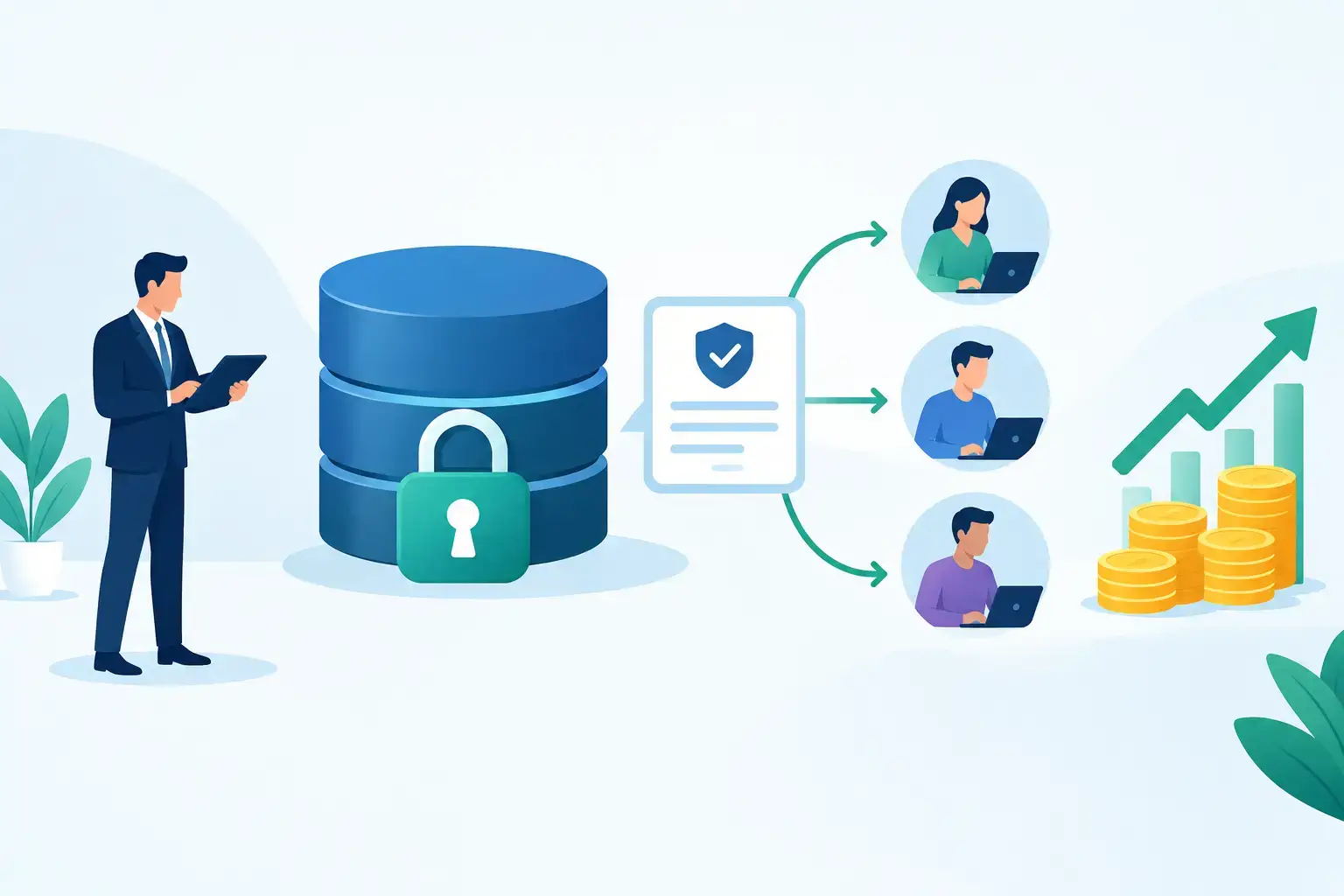
A customer support archive can look like a cost center until an AI lab needs real examples of how businesses solve difficult, high-context problems. The same may be true of CRM histories, workflow records, internal knowledge bases, and operational documents. Business data licensing gives companies a structured way to evaluate whether those records can become a new revenue source, without treating sensitive information as something to hand over casually.
The distinction matters. A company does not need to expose files, connect systems, or make broad promises simply to learn whether its data may be commercially valuable. A well-run licensing process starts with an inventory and a rights review. Only then can a company define what, if anything, it is willing and able to license.
What business data licensing actually means
Business data licensing is a commercial arrangement in which a company grants defined rights to use a specified dataset under agreed conditions. In the AI market, the buyer may be an AI lab seeking legally sourced, context-rich material for model development, evaluation, or related research. The supplier remains focused on the conditions of access: which records are included, what is excluded, how the data is prepared, permitted uses, confidentiality requirements, and commercial terms.
This is not the same as selling a database outright. A license should be specific about scope and use. It may cover a particular collection of de-identified support conversations from a defined period, for example, rather than every record in a company’s systems. It may permit model training but not onward distribution, or it may require the buyer to maintain strict controls over access and retention.
The details depend on the records, applicable contracts, privacy obligations, and buyer requirements. That is why an indicative valuation is not a final offer, and why no responsible process treats a data export as the first step.
Why operational records have growing value
AI systems improve when they encounter examples that reflect how work actually happens. Public internet text has scale, but it often lacks the operational context found inside established businesses. A well-organized support platform may capture issue diagnosis, product knowledge, escalation patterns, and final resolutions. A CRM can show commercial processes and account interactions. A knowledge base can document specialized procedures built through years of practice.
Structured events can be valuable for a different reason. Records from workflows, service operations, transactions, or business processes may show sequences, decisions, exceptions, and outcomes. These patterns can help support development of systems designed to reason about practical work rather than merely produce fluent text.
That value is real, but it is not automatic. Data is more likely to be commercially relevant when it has useful volume, consistency, clear provenance, and meaningful context. A large collection of duplicate, poorly labeled, or highly restricted records may have less practical value than a smaller, well-organized dataset with a clear rights position.
The commercial opportunity requires a rights-first approach
A company may create and maintain valuable records without having unrestricted rights to license every field, file, or conversation within them. Customer agreements, vendor terms, employee information, intellectual property rights, regulated data, and confidentiality commitments can all limit what is appropriate to include.
For that reason, the first business question is not, “How much is our data worth?” It is, “What data do we control, what rights do we have, and what use could we responsibly permit?” Legal, security, privacy, and operational stakeholders should all have a role in answering it.
A disciplined review typically considers the source systems, record types, date ranges, data subjects, existing contractual commitments, and applicable laws. It also identifies obvious exclusions early. A company may decide that certain customers, jurisdictions, categories of documents, or sensitive fields are out of scope before discussing a transaction with a buyer.
This does not eliminate complexity. It gives the company a defensible basis for evaluating the opportunity and prevents a promising revenue conversation from becoming an uncontrolled disclosure exercise.
A practical process for evaluating a license
The strongest process is sequential. Start with an internal inventory rather than a transfer. Identify the systems that may contain valuable records, such as Salesforce, Zendesk, Intercom, HubSpot, Jira, Confluence, Google Workspace, Snowflake, or PostgreSQL. At this stage, high-level descriptions, record counts, time periods, schemas, and representative categories can be enough to assess potential fit. No upload or system connection should be required merely to qualify the opportunity.
Next, define the possible dataset. This means moving beyond a vague label such as “support data” and documenting what the proposed scope could include. Are the records tickets, chat conversations, resolution notes, attachments, product logs, or all of the above? What dates are covered? Which fields carry useful context, and which fields should be removed? Precision here improves both buyer review and supplier control.
Then comes the rights and restrictions review. The company should determine whether licensing is permitted, what consents or notices may be relevant, and what contractual conditions should govern use. This is where general counsel, privacy leaders, and security teams can turn broad concerns into concrete requirements.
Once a buyer expresses interest, commercial and legal terms should be documented before delivery. The agreement should address authorized uses, confidentiality, security expectations, restrictions on sharing, retention or deletion obligations, ownership, payment conditions, and the approval process. The buyer’s intended use should be clear enough that the supplier can evaluate it on its merits.
Only after the scope and protections are agreed should de-identification and delivery be considered. Depending on the dataset, this may involve removing direct identifiers, excluding sensitive fields, filtering records, replacing values, or applying other controls appropriate to the data and permitted use. De-identification reduces risk, but it is not a substitute for a sound legal and contractual framework.
The buyer then reviews the delivered dataset against the agreed criteria. Payment generally follows buyer acceptance under the signed agreement. That sequence protects both sides: the buyer can validate quality and usability, while the supplier retains control until defined conditions are in place.
What good governance looks like in practice
Governance should not be a vague approval checkpoint at the end of a project. It should shape the transaction from the first inventory through final delivery. The company needs a clear internal owner, but that owner should have access to the people responsible for data systems, contracts, privacy, security, and the business unit that understands how the records were created.
The most useful governance decisions are specific. Instead of saying that data must be “safe,” define the categories that cannot be included. Instead of requesting “limited use,” state whether model training, evaluation, fine-tuning, internal research, or derivative dataset creation is allowed. Instead of relying on a general confidentiality statement, identify who can access the data and what must happen at the end of the permitted term.
Companies should also recognize that buyer requirements vary. One AI lab may need a large, consistently formatted corpus. Another may value a narrower dataset with unusually strong domain expertise. A dataset that is unsuitable for one buyer may still be relevant to another, provided the rights and use case align. The right commercial path depends on quality, relevance, legal posture, and the controls both parties can support.
Treat the data dividend with appropriate discipline
Operational data is created through real work: customer interactions, product delivery, service resolution, compliance processes, and the daily decisions that keep a business running. When that data can be responsibly licensed, the company that created it should have an opportunity to participate in its economic value.
That is the premise behind a data dividend. It is not a claim that every archive should be monetized or that every dataset will command the same price. It is a practical position: companies should be able to assess a legitimate revenue opportunity without sacrificing privacy, confidentiality, or control.
Datumi supports this kind of evaluation through a controlled, buyer-led process built around inventory, defined scope, rights review, de-identification, and payment after acceptance. For companies with organized business records, the useful first move is not a data upload. It is a careful conversation about what the company has, what it can license, and the conditions under which it would be willing to do so.