November 16, 2026
AI Training Data: Why Business Records Matter
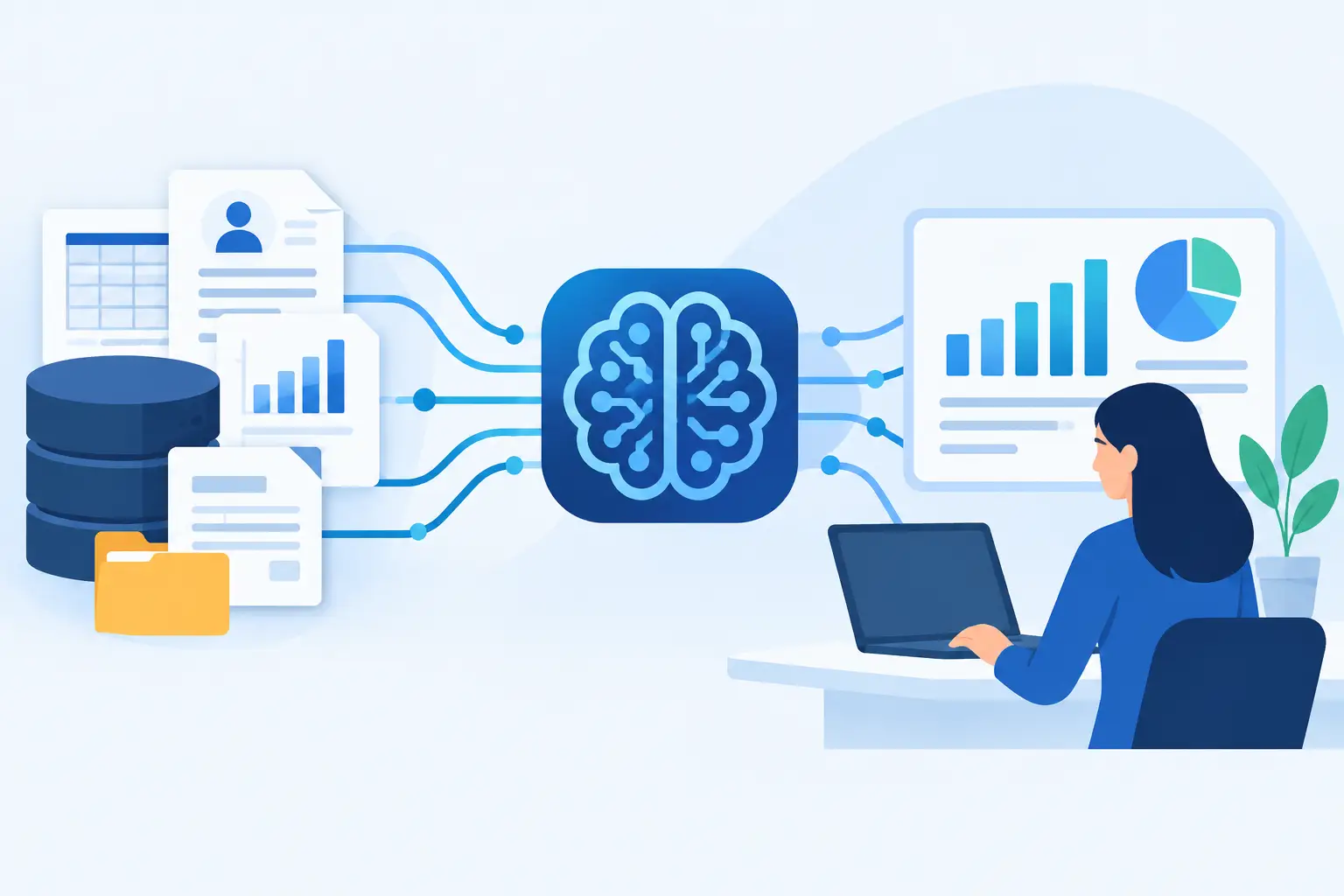
A support ticket that explains an unusual customer issue, the CRM history behind a renewal, or a workflow record showing how a team resolved an exception may look ordinary inside a business system. For an AI lab, carefully governed AI training data with that level of operational context can be far more useful than generic text scraped from the public web.
That difference is creating a legitimate commercial question for data-owning companies: are the records produced in the normal course of business an underused asset? The answer depends on quality, rights, privacy, and buyer demand. It also depends on whether the company can evaluate the opportunity without taking shortcuts on confidentiality or control.
What AI Training Data Actually Means
AI training data is the material used to help a model recognize patterns, follow instructions, reason through tasks, or produce useful outputs. It can include text, images, audio, code, and structured records. For business-focused models, valuable training material often comes from the systems companies already use to run their operations.
Examples include customer support conversations, help-center articles, CRM notes, sales and renewal histories, internal knowledge bases, ticket workflows, business documents, product feedback, and structured events from operational databases. The value is not simply that these records exist. It is that they capture how real organizations describe problems, make decisions, coordinate work, and document outcomes.
A model trained only on broad public information may know general concepts. A model exposed to properly licensed, de-identified operational records can learn the language and structure of practical business work: how a billing dispute is investigated, how an implementation risk is escalated, or how a support agent turns incomplete information into a resolution.
Not every dataset is suitable for every model-development need. A large volume of repetitive records may have less value than a smaller, well-organized collection with clear outcomes and consistent context. Recency, industry relevance, record quality, and permitted use all affect commercial interest.
Why High-Context Business Records Have Value
Publicly available data is abundant. High-quality business context is not. Companies generate it through years of customer interactions, operating procedures, system usage, and employee judgment. That history can be difficult to reproduce synthetically because it reflects actual constraints, exceptions, and decisions.
Consider the difference between a generic article about customer onboarding and a set of de-identified implementation records. The article may describe best practices. The records may show the real sequence of questions, blockers, handoffs, documentation, and resolution paths that occur when a customer deploys a product. Both have uses, but they are not interchangeable.
This is why records from systems such as Salesforce, Zendesk, Intercom, HubSpot, Jira, Confluence, Google Workspace, Snowflake, and PostgreSQL may be commercially relevant. They often contain connected operational signals rather than isolated text. A support case may link to a product issue, a knowledge-base article, a resolution code, and a follow-up task. That context can matter to buyers developing specialized models and evaluation datasets.
Still, commercial relevance does not automatically create a right to license data. A company must distinguish between having access to a system and having the authority to grant training rights over its contents.
The First Question Is Rights, Not Revenue
Before discussing pricing or delivery, a company should identify what it owns, what it is permitted to use, and what it must exclude. Contracts with customers, vendors, employees, and platform providers can create restrictions that change the scope of a potential transaction.
Customer agreements may include confidentiality commitments, limits on data use, or specific provisions governing service data. Vendor agreements may address export rights and platform restrictions. Regulated information, trade secrets, personal data, financial details, credentials, source code, and sensitive internal strategy may require exclusion even where a company otherwise has broad rights over the records.
This is why an inventory should precede any transfer. The inventory is not a request to upload files. It is a structured assessment of the systems involved, the record types they contain, likely volume, time periods, data fields, and known restrictions. It lets the company decide whether there is a viable dataset before exposing underlying content.
Legal, privacy, security, operations, and data leaders should all have a role in this review. The goal is not to force every record into a deal. The goal is to define a dataset the company can stand behind.
AI Training Data Requires a Defined Scope
A credible licensing process treats scope as a written business and governance decision. “All our support data” is not a workable definition. It leaves too many questions unanswered: Which teams? Which date range? Which fields? Which jurisdictions? Which customer segments? What uses are allowed? What must be removed?
A useful scope might cover de-identified customer support conversations and ticket metadata from a defined period, while excluding enterprise accounts under restrictive contracts, attachments, payment details, account identifiers, and any records involving regulated matters. The precise scope will vary by company and buyer need.
Permitted use matters just as much as record selection. A supplier may be comfortable licensing records for model training and evaluation but not for redistribution, public display, or use in a competing product category. These conditions should be addressed before transfer, not assumed after the fact.
The strongest commercial process gives the data-owning company approval over scope, exclusions, and contractual conditions. That control is not an obstacle to monetization. It is what makes responsible monetization possible.
De-Identification Is a Process, Not a Label
Removing obvious names is rarely enough. Business records can contain email addresses, phone numbers, account numbers, locations, dates, free-text details, and combinations of facts that create re-identification risk. Attachments and metadata can introduce additional issues.
De-identification should be designed around the specific dataset and its intended use. In some cases, direct identifiers can be removed while preserving useful structure, such as ticket category, product area, issue type, resolution status, and elapsed time. In others, a record type may be too sensitive or too difficult to prepare safely and should be excluded.
There is a trade-off. The more context retained, the more useful a dataset may be to a buyer. The more identifying or confidential detail retained, the greater the governance challenge. Responsible dataset preparation works within that tension rather than pretending it does not exist.
Companies should also preserve a clear separation between initial qualification and data delivery. A prospective supplier should not need to connect systems or upload raw records simply to learn whether an opportunity may exist. Qualification can begin with a high-level inventory and a discussion of rights, scale, record types, and exclusions.
How a Controlled Commercial Process Works
The commercial pathway should be understandable to both business leaders and counsel. It generally begins with an inventory of relevant systems and record categories, followed by an initial assessment of buyer interest. Any indicative value should be treated as preliminary, not as a guaranteed offer.
If there is mutual interest, the parties define the proposed dataset, review licensing rights and restrictions, and negotiate confidentiality and permitted-use terms. Only after the scope and agreement are settled should de-identification and delivery move forward.
The buyer then reviews the prepared dataset against agreed criteria. Acceptance matters because buyers need to confirm that the delivered material meets the requirements of their model-development program. Payment should follow buyer acceptance under the signed transaction terms.
Datumi is built around this controlled pathway: no data uploads or account connections during qualification, written scope and use controls before transfer, and a buyer-led process for reviewing licensed datasets. For suppliers, that structure creates a way to assess a potential new revenue channel without treating sensitive operational information casually.
What Makes a Dataset More Marketable
There is no universal formula, and volume alone is not enough. Buyers typically look for records that are lawful to license, relevant to a defined use case, internally organized, and capable of being prepared under clear controls.
A company is often in a stronger position when its records have consistent schemas or workflows, meaningful historical depth, clear documentation, and useful outcome signals. A support dataset with issue categories and resolution status may be easier to evaluate than a large collection of unstructured files with no context. A knowledge base tied to real customer questions may be more useful than generic internal documents.
Industry specialization can also matter. Operational data from sectors with complex workflows may carry meaningful context, but those same sectors may have stricter legal, contractual, or regulatory limits. A valuable dataset is not one that includes everything. It is one that preserves useful patterns while respecting the boundaries that apply to it.
Treat Business Data as an Asset With Conditions
For many companies, the records created through daily operations have never appeared on a balance sheet or in a revenue plan. That does not mean they lack economic value. It means the company has not yet had a controlled way to evaluate that value.
The appropriate posture is neither “license everything” nor “data can never be monetized.” It is to identify the records your business creates, establish the rights and restrictions around them, and decide what could be offered under terms you are prepared to enforce. When the process starts with control, a data dividend can become a considered commercial option rather than an unnecessary exposure.